
Bellevue
At our Bellevue retina center, we offer the highest level of retinal care, diagnosis, and treatments available throughout the Eastside. Our retina specialists and surgeons treat the full spectrum of retinal and macular diseases, including macular degeneration, diabetic retinopathy, and more. Our Bellevue retina center is conveniently accessible to patients from many local communities, including Kirkland, Redmond, Renton, and Sammamish. You don’t need to travel to downtown Seattle for world-class care. Call us today.
Address
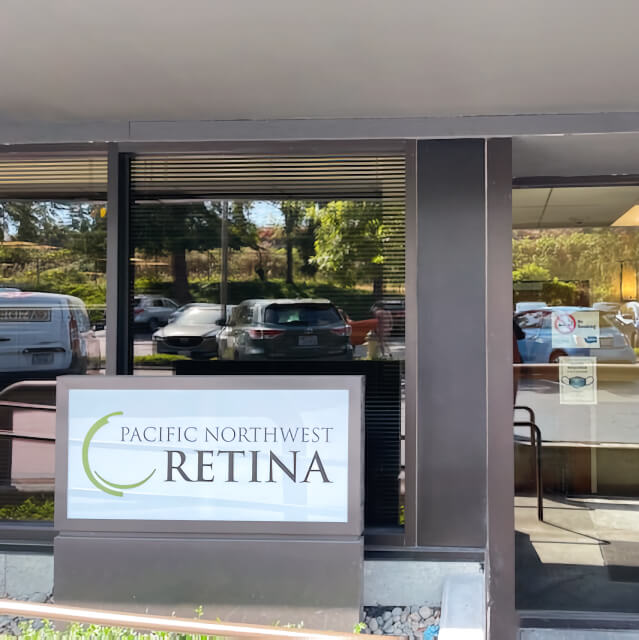
1750 112th Ave NE, Suite D 050
Bellevue, WA 98004
Phone: 206-215-3850
Fax: 206-215-3870
Hours
Monday - Friday
8:00 AM - 5:00 PM
Saturday
8:30 AM - 1:00 PM
Sunday
Closed
Retina Care at Bellevue
Diabetic retinopathy is an eye condition caused by damage to the small blood vessels in the retina due to diabetes. Over time, high blood sugar levels can cause these vessels to leak, swell, or become blocked, interfering with normal vision. One common complication is diabetic macular edema (DME), which occurs when fluid builds up in the macula — the part of the retina responsible for sharp, central vision. Diabetic retinopathy may develop without noticeable symptoms early on, making regular eye exams essential for people with diabetes.
Macular degeneration, often referred to as age-related macular degeneration (AMD), is a condition that affects the macula and leads to the gradual loss of central vision. It can make everyday tasks like reading, recognizing faces, or driving more difficult, while peripheral vision typically remains intact. AMD comes in two main forms — dry and wet — with wet AMD being less common but more aggressive. Symptoms may include blurred or distorted central vision and difficulty seeing fine details. Early detection plays an important role in preserving vision.
Retinal vein and artery occlusions occur when blood flow to or from the retina becomes blocked, disrupting the retina’s ability to function properly. A vein occlusion prevents blood from draining out of the retina, while an artery occlusion limits oxygen-rich blood from reaching it. Both conditions can lead to sudden or gradual vision changes and are often associated with underlying health issues such as high blood pressure, diabetes, or cardiovascular disease. Symptoms may range from mild blurriness to significant vision loss, typically affecting one eye and requiring prompt evaluation.
Flashes and floaters are visual disturbances that appear as flickering lights, spots, threads, or cobweb-like shapes in your field of vision. Floaters are often caused by age-related changes in the vitreous gel inside the eye, while flashes can occur when the vitreous pulls on the retina. Although common and often harmless, a sudden increase in flashes or floaters or the appearance of a shadow or curtain in vision can signal a more serious retinal issue and should be evaluated promptly.
A retinal tear occurs when the retina develops a small break, often due to traction from the vitreous gel as it shifts with age. If fluid passes through the tear, it can cause the retina to separate from the back of the eye, resulting in retinal detachment. This is a serious condition that can threaten vision if not treated quickly. Symptoms may include flashes, floaters, blurred vision, or a dark curtain moving across the visual field. Prompt diagnosis is critical.
Macular conditions affect the central portion of the retina responsible for detailed vision. A macular hole is a small opening that forms in the macula, often due to age-related changes in the vitreous. An epiretinal membrane (sometimes called macular pucker) occurs when a thin layer of scar tissue forms on the macula’s surface, causing distortion or blurriness. These conditions can lead to wavy or blurred central vision and difficulty with fine visual tasks.
In addition to the more common retinal conditions listed above, retina specialists also diagnose and manage a wide range of less common, complex, or inherited eye conditions. These conditions may affect the retina, macula, vitreous, or underlying structures of the eye and can impact vision in different ways—from gradual changes to sudden visual symptoms.
Additional retinal conditions we evaluate and manage include: